Sound change and analogy
What a paradigm does when a sound change reaches it, how analogy replaces a form, and what a word left without sounds looks like.
Follow a paradigm through a sound change, replace a form with analogy, and decide what happens to a word that loses every sound. Kobu continues from Make forms with a derivation, with four forms for each noun.
A sound change takes an ending
Point at the row above Middle Kobu, press +, choose Sound change, type t > ∅ / _# and press Enter. The genitive loses its ending.
Open the Paradigms tab of Middle Kobu. The table is still there, since a sound change leaves glosses and features alone. Cells with the same form now carry the same letter, and pointing at one names the cells it shares its form with.
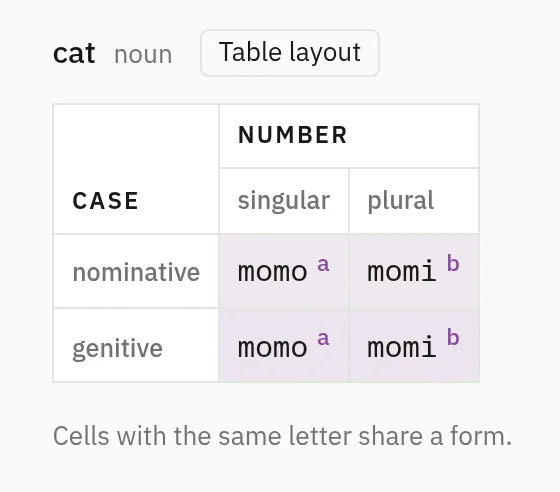
Dog keeps a difference: kuko in the nominative singular and kuku in the genitive singular, left by the earlier u > o / _#.
Analogy
Analogy replaces the form of words that exist, in place. The word keeps its features, examples and page, and later changes apply to the new form. To add a form, use a Derivation.
- Point at the row above Middle Kobu, press + and choose Analogy.
- Under Words, set
Glossisdog,CaseisgenitiveandNumberissingular. - Under New form, press A rule and type
u > o / _#. Written out gives one word a form you type. - Under Model words, press Add model word and pick cat's genitive singular the same way.
- Write a Note, which is optional, and press Add.
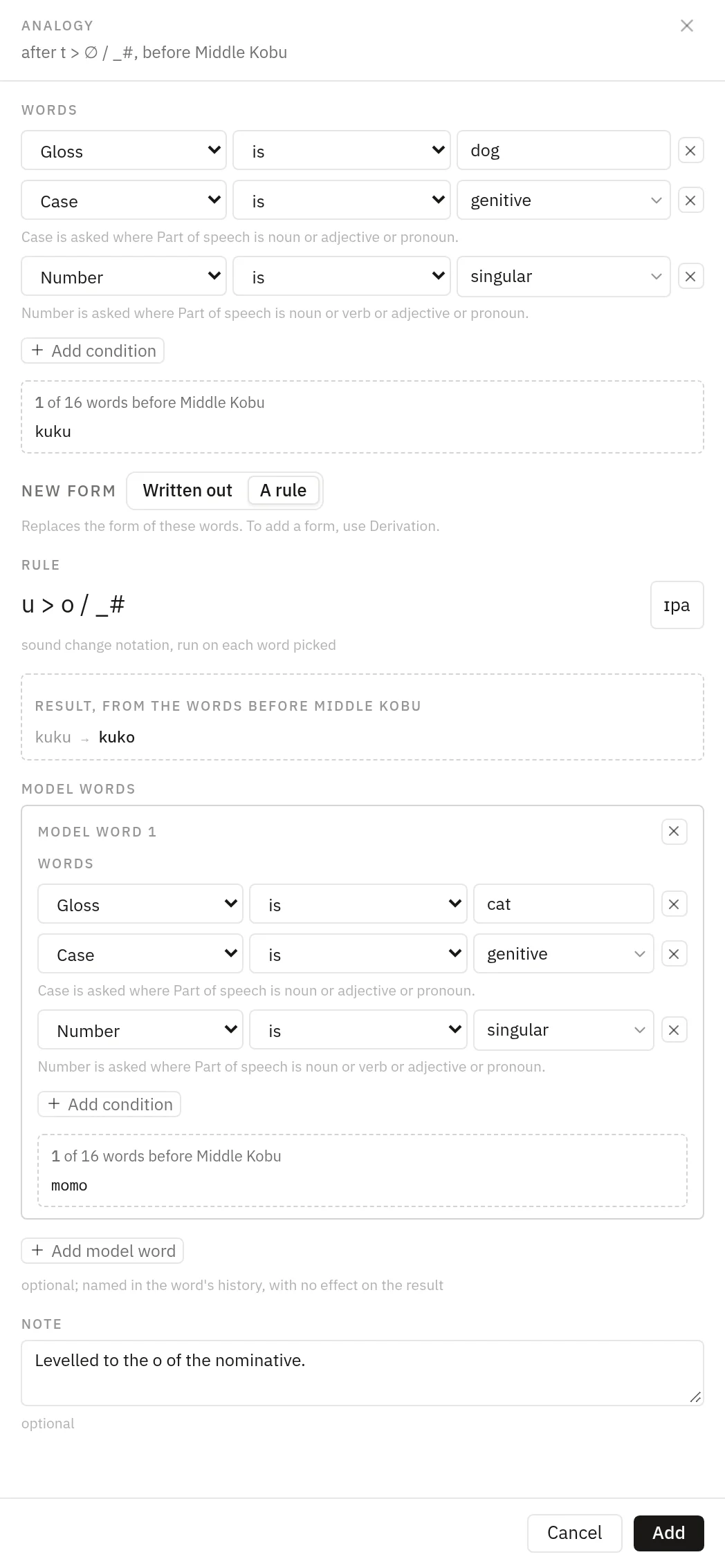
Model words are a citation. The word's history names them beside the new form, and they have no effect on the result. Press the word's column heading to read it.
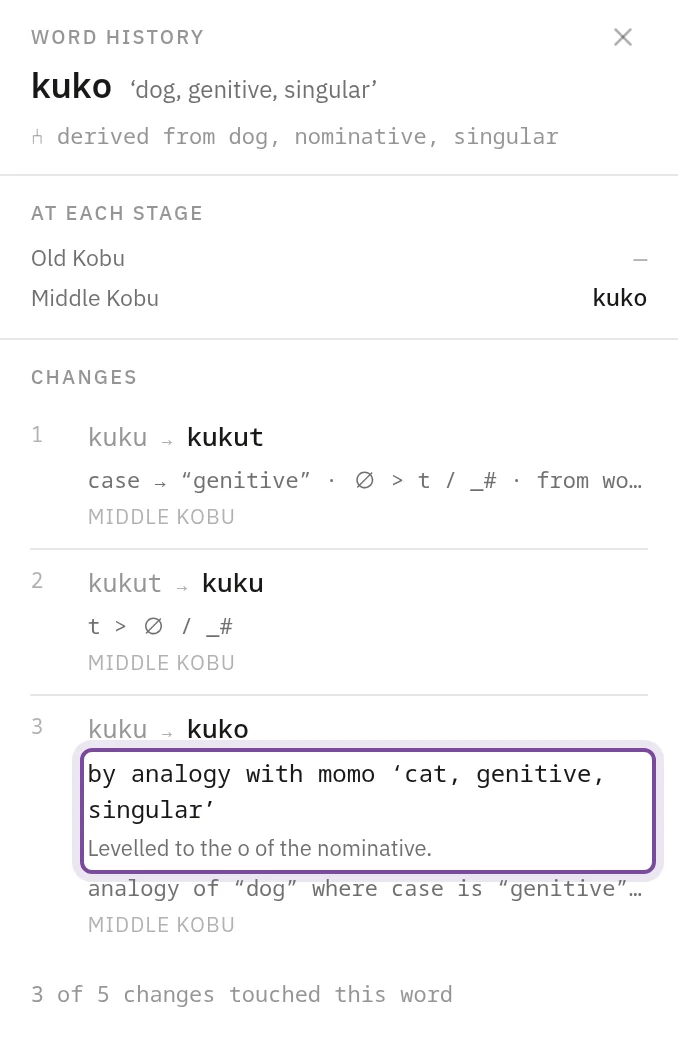
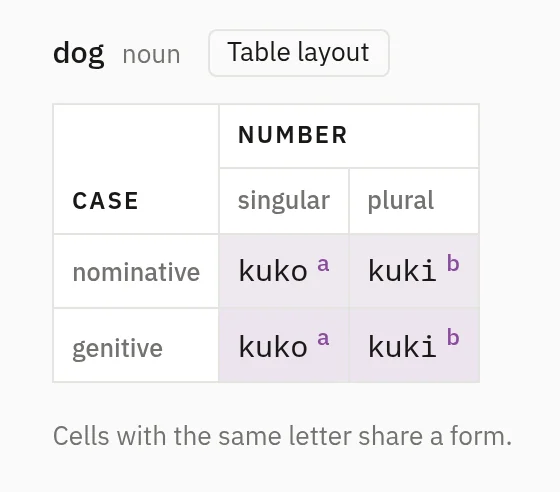
Dog now reads like cat.
Words without sounds
A rule can take every sound of a word. Add the Sound change a > ∅ / _#, and egg has none left. The run goes on and the edit stands, and a dialog names the words.
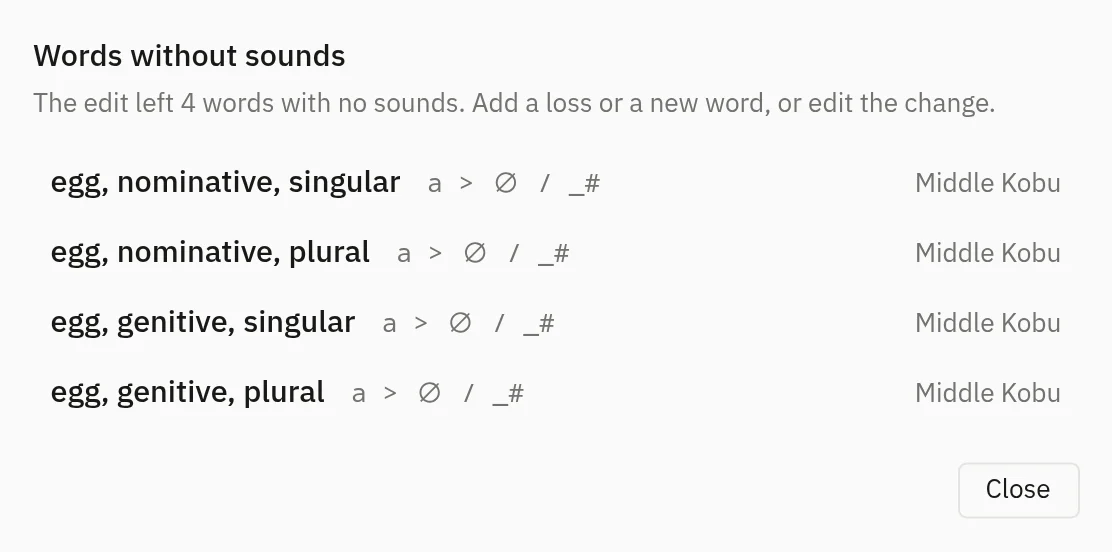
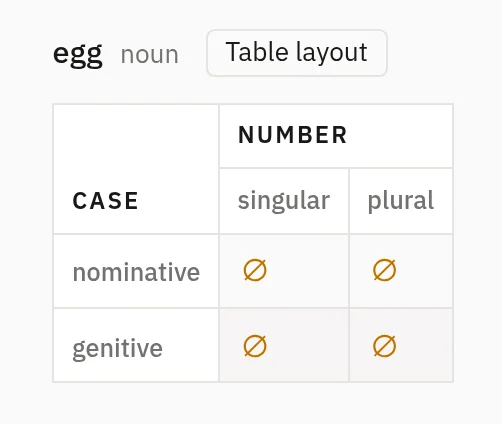
Each of these words stays on the line, marked ∅ in its column and in its table. The change's row counts them, and so does the head of the editor, where pressing the count lists the changes.
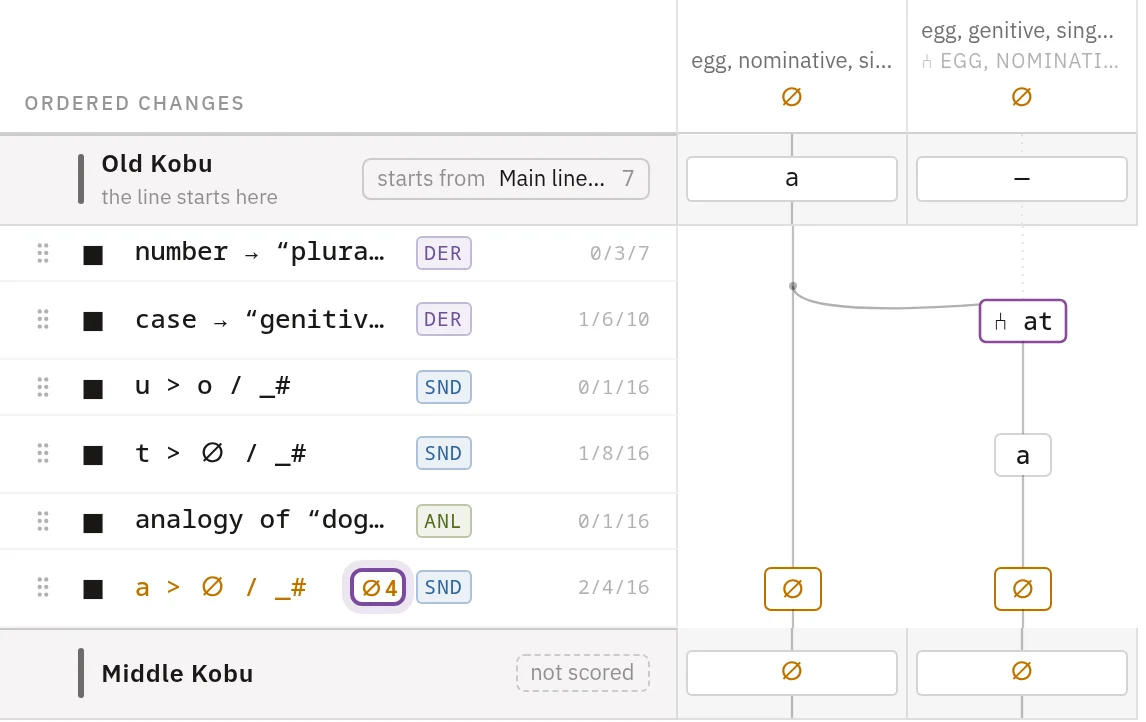
A cell with ∅ shares its form with no other cell, so it carries no letter.
What you do next depends on what happened in the language.
| In the language | In the editor |
|---|---|
| The word fell out of use | Add a Loss |
| Another word took its place | Add a Loss and a New word |
| The word survived | Narrow the rule, or give it a form with an Analogy, Written out |