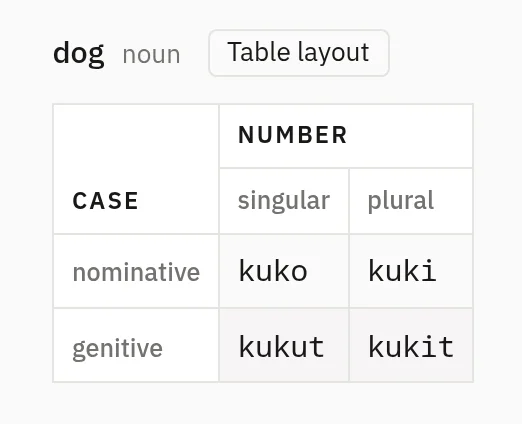
Make forms with a derivation
A whole case or number made by one change, and how the order of changes decides what each form is built from.
Make a whole case or number at once. A Derivation picks a class of words and makes a new form of each by a rule, and every new form is a word of its own. A derivation works only between stages: the first stage is filled from the lexicon.
Kobu continues from Paradigms. Cat has its four forms, and the other nouns have a nominative singular. The second stage is called Middle Kobu.
Make the plurals
-
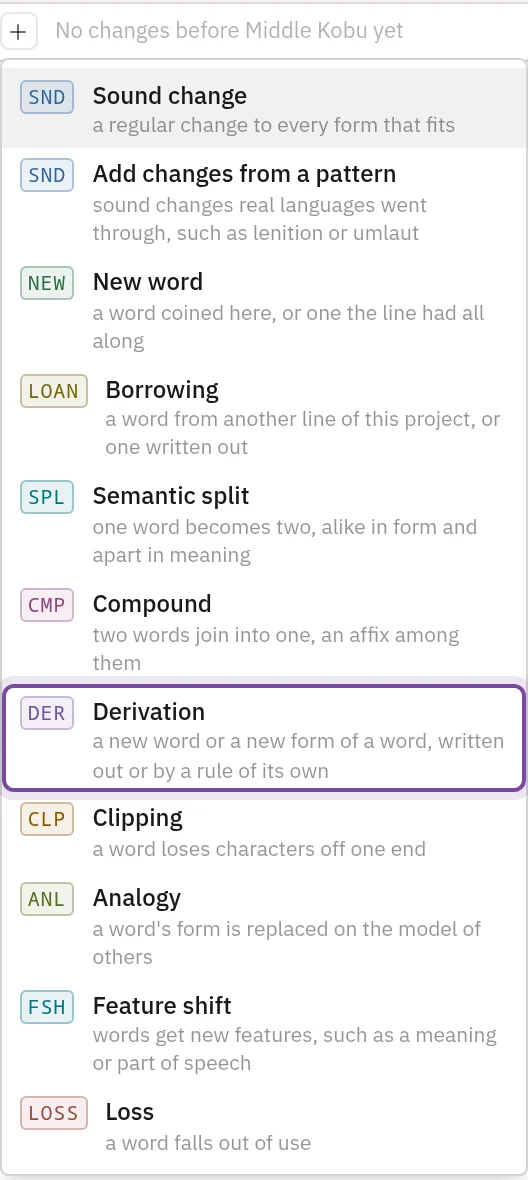
Point at the row above Middle Kobu, press + and choose Derivation.
-
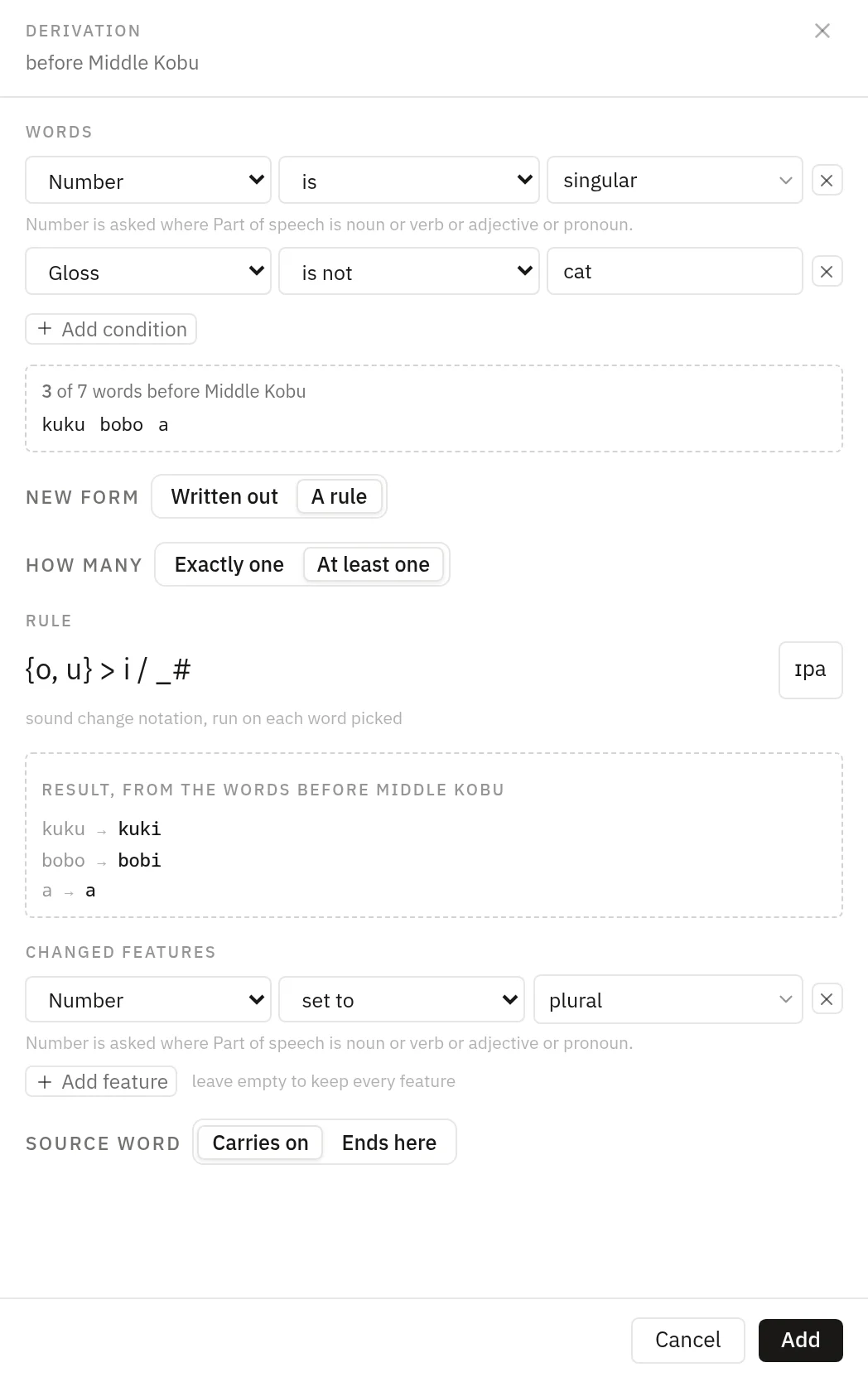
Under Words, set
Numberissingular. Press Add condition and setGlossis notcat, since cat has its plurals. -
Under New form, press A rule. Under How many, press At least one.
-
In Rule, type
{o, u} > i / _#. -
Under Changed features, set
Numbertoplural. -
Keep Source word on Carries on, and press Add.
The Result block shows each new form while you fill in the panel.
A derived word inherits its parent's features plus the changed ones, so kuki is a noun glossed dog, nominative and plural. It gets a column of its own in the matrix.
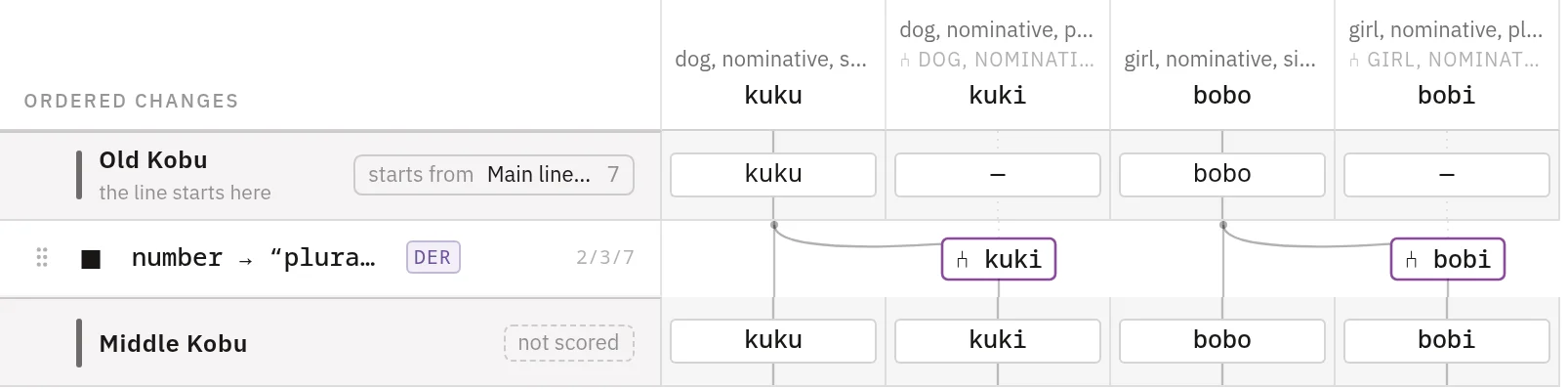
Where the rule does not fit, the form is copied. a has no final o or u, so its plural is a too, and the two cells carry the same letter.
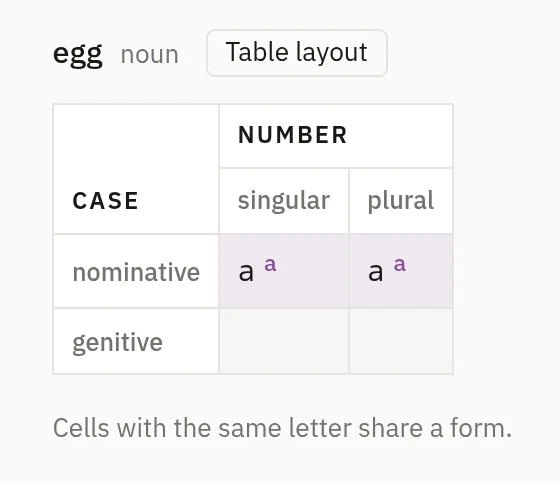
Make the genitives
Add a second Derivation below the first, with A rule and At least one again: Words Case is nominative and Gloss is not cat, Rule ∅ > t / _#, and Case set to genitive. It reads the words the first one made, so the plurals get a genitive as well.
_ marks the sound that changes, # the edge of a word and ∅ nothing. The IPA keyboard beside the field types ∅. See Sound changes.Choose what a form is built from
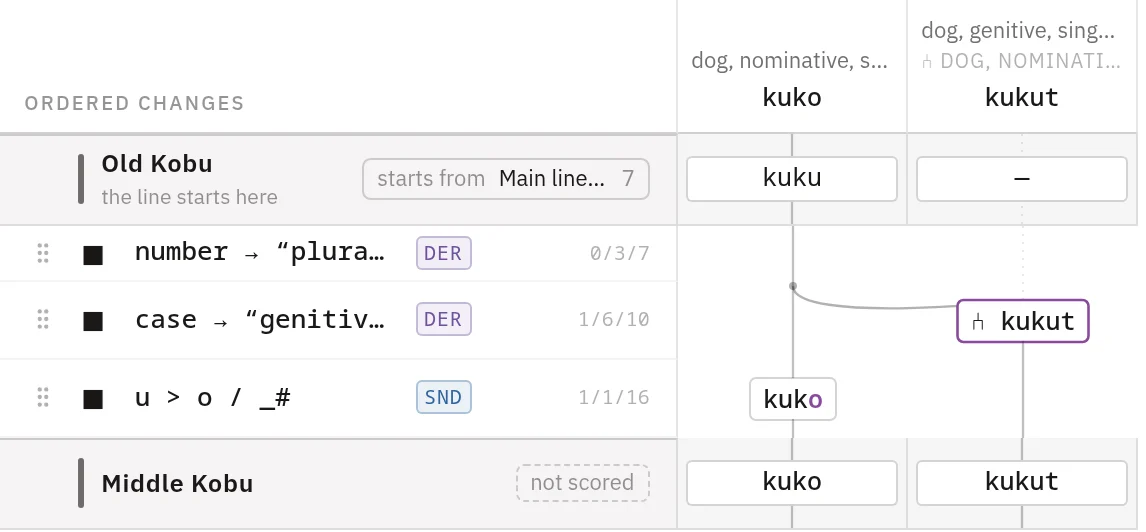
Changes run from top to bottom, and each reads the words as the changes above it left them. A form derived before a later change is built from the older form, so the order decides which forms a sound change reaches.
Press + on the row of the last derivation, choose Sound change, type u > o / _# and press Enter. kuku becomes kuko. kukut was built from kuku before this change, and its u is no longer at the end, so it keeps it.
Drag the sound change above the genitive derivation by the grip at the start of its row. The derivation now reads kuko and makes kukot.
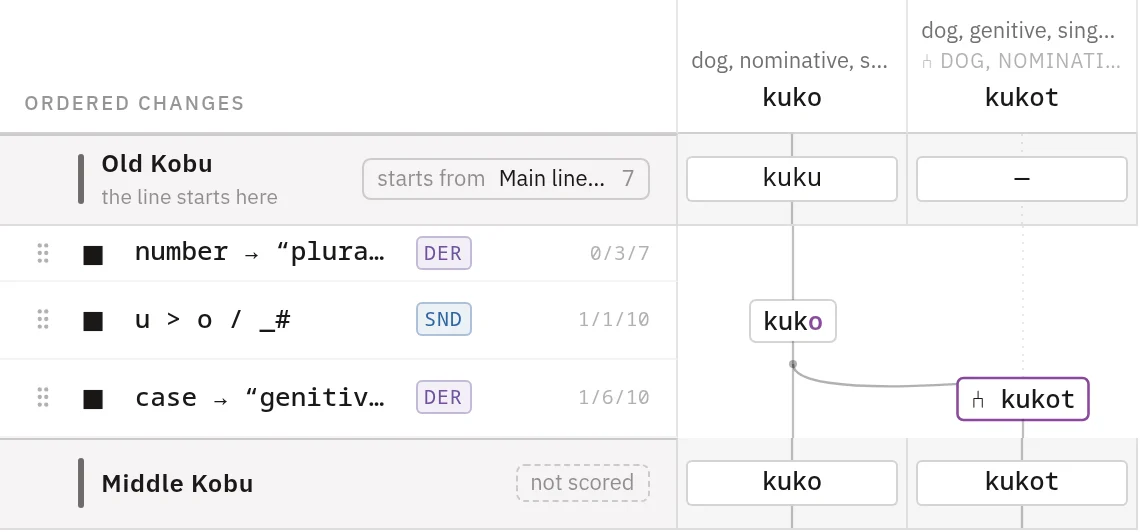
Use the order that gives the forms you want. Kobu keeps the first: drag the sound change back below the derivation, and dog has a stem that alternates.