Borrowings
Take a word from another line or from the line's own past, and steer how it fits the sounds where it enters.
A borrowing brings a word into a line at one point of its history. The word arrives as it stood where it was taken, gets the sounds of the line where it enters, and then goes through the changes after that point like any other word. The examples come from the Latin to Castilian demo, where Castilian takes words back from Latin as learned words.
Borrow a word
- Point at a row of the matrix, press + and choose Borrowing. The word enters at that row.
- Under From, keep From this project.
- Choose the line to borrow from, and its Stage. A line can borrow from itself, marked its own past, at any stage it has already been through.
- Under Words, set conditions that find one word there, such as
Glossisgrass. The panel shows the word it finds. - Press Borrow.
A line that runs after this one can't lend to it, so it isn't offered, and where no line can lend at that point the panel says so. Written out takes a word from outside the project: type its form in IPA and name the language under Borrowed from. Its form is adapted in the same way.
In the matrix, a borrowed word joins the line at its row, and the row names where it came from.
The adapted form
Under Adapted form, the panel shows the source form and the adapted form beside it, with the replaced sounds underlined. Steps lists each replacement with its reason.
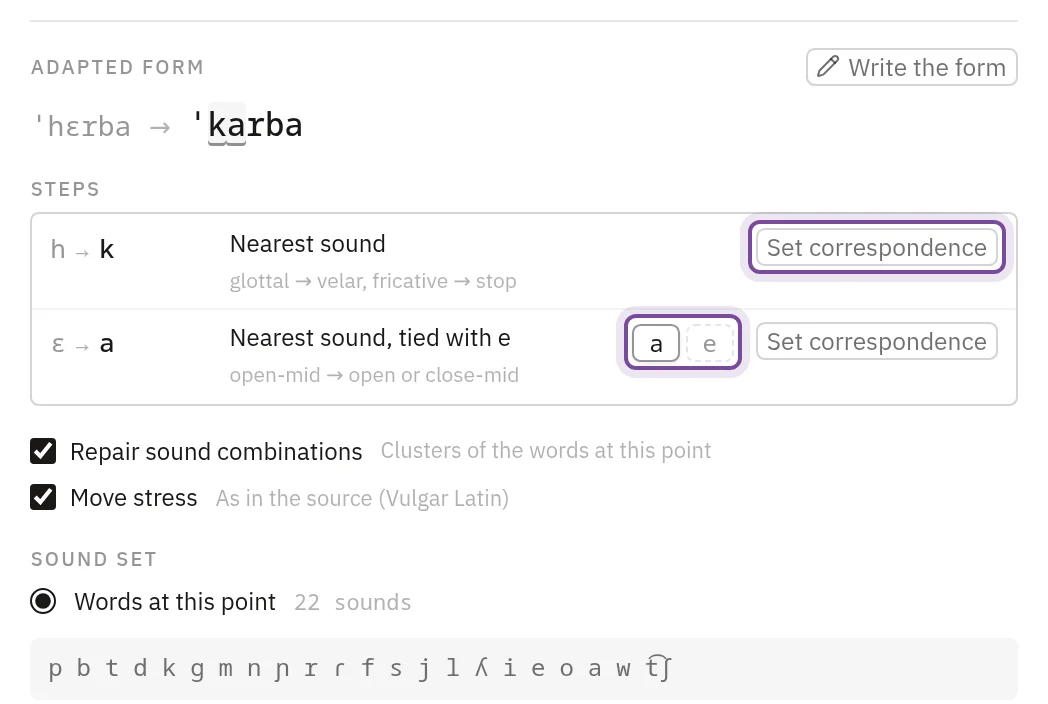
A sound the line has stays as it is. A sound it lacks becomes the nearest sound it has, and the step names the features that moved, as glottal → velar for h → k. Where two sounds are equally near, the step says tied and shows both. The one the line's words use more is taken until you press the other, which then holds for this word alone, marked In this word.
Correspondences
History often took another sound than the nearest one. Latin h had long fallen silent when Castilian took learned words from Latin, so herba enters without it. A correspondence sets the replacement for one sound.
- In the step for h, press Set correspondence.
- Type the sound it becomes, or leave the field empty to drop it. Nearest offers the sounds the panel would take.
- Press Set h → ∅.
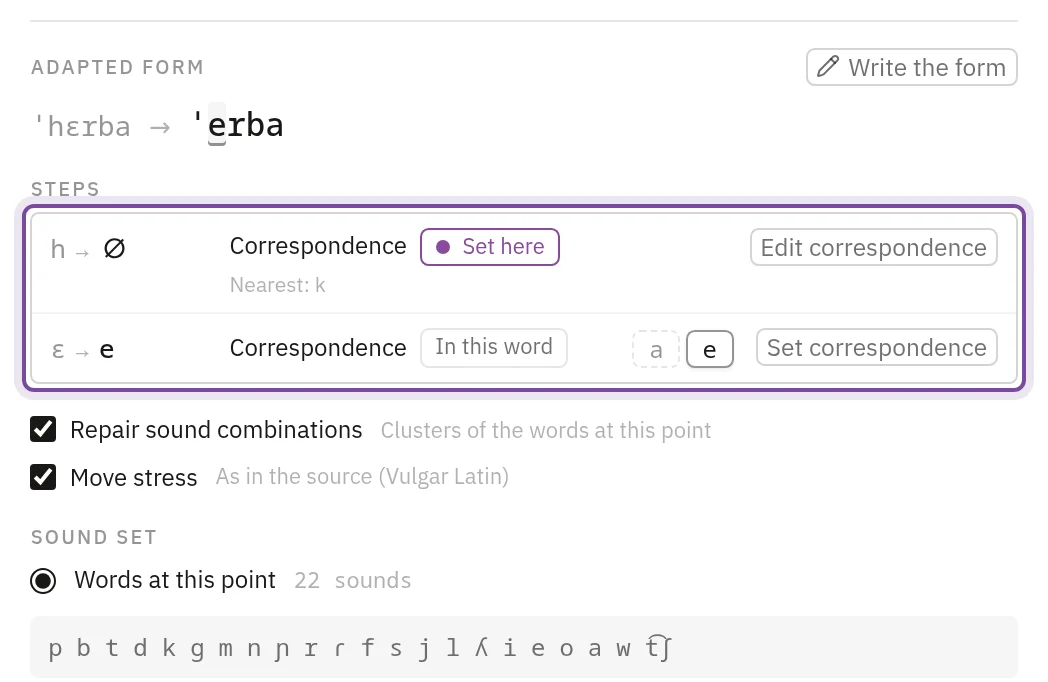
A correspondence set from a step belongs to the stage above the borrowing's row, so it holds for every borrowing at that stage and later, and on the lines that split later. The editor names the other borrowings it changes before you set it. A step whose correspondence comes from an earlier stage says From and that stage. Edit correspondence changes or removes one set here.
The stage's settings list the correspondences in force there under Correspondences, where Add correspondence sets one without a borrowing. A correspondence for the same sound at a later stage takes the place of the earlier one.
Sound combinations and stress
Repair sound combinations fixes clusters the line doesn't allow where the word enters. Clusters at the start of a word, between vowels and at its end are checked apart, against the syllable templates in force or, where there are none, against the clusters of the line's words. Move stress puts the primary stress on the line's fixed stress, and the note beside it says where that is. Clear either box to keep the word's clusters or its stress as they are.
How a cluster is fixed is set per stage. Open the stage above the borrowing's row and find Sound combinations in its Settings.
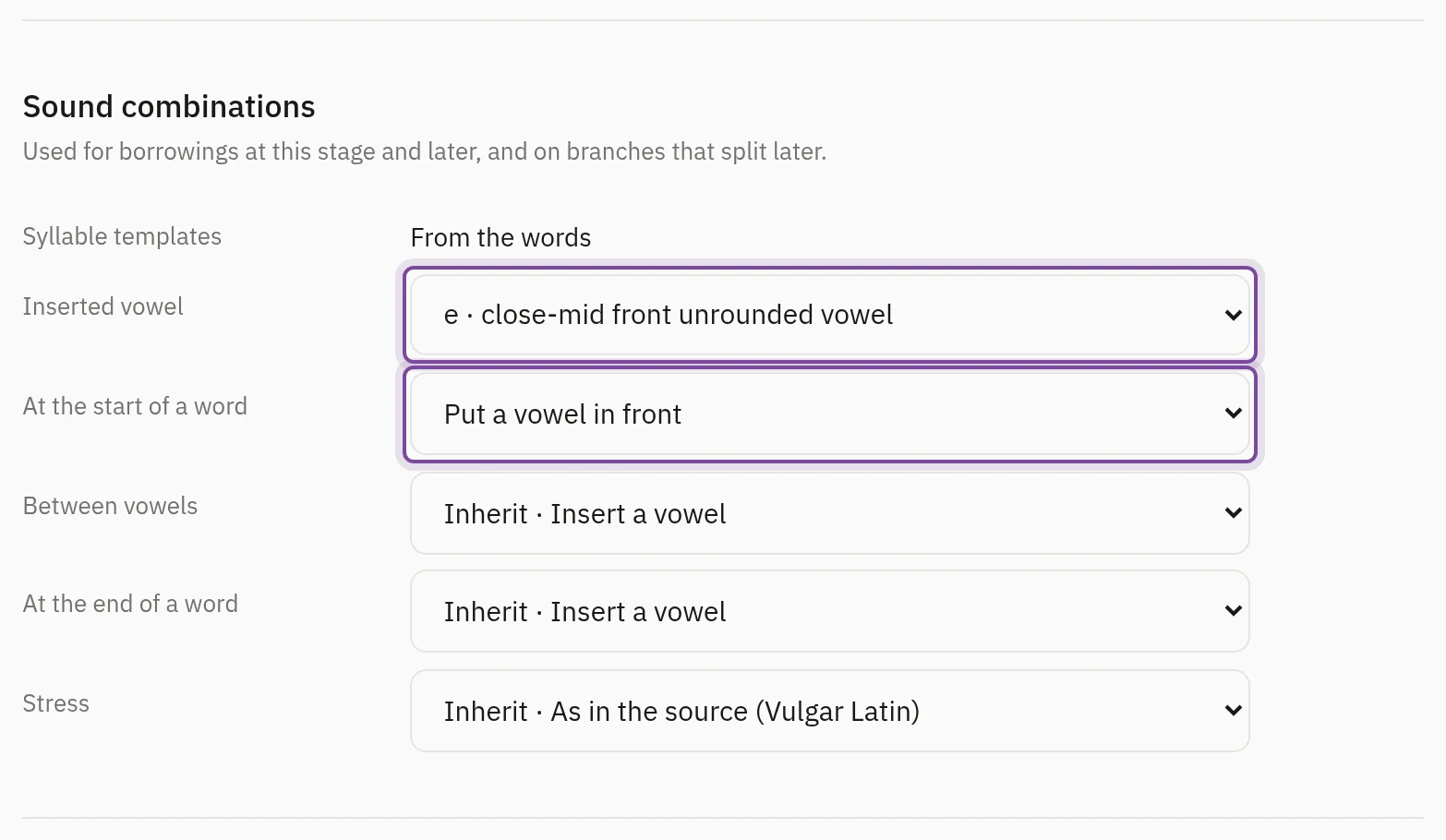
Each place takes Insert a vowel or Drop a consonant, and the start of a word can also Put a vowel in front. Inserted vowel names the vowel, the one the line's words use most until you choose another. Stress chooses the syllable the borrowings stress, or keeps the stress of their source. Each setting holds at later stages and on the branches that split later, until a later stage sets it again.
Latin schola borrowed with the default settings comes out as saˈkola, a vowel inserted inside the cluster. With the settings above it comes out as esˈkola, the way Castilian treats an s before a consonant at the start of a word.
Sound set
The sound set is what the word is adapted to. Words at this point takes the sounds the line's words have where the borrowing enters, and Inventory in force takes the inventory in force there. The strip below lists the sounds. A sound an earlier borrowing kept is underlined with dots, and pointing at it names that borrowing.
Write the form by hand
Press Write the form to type the form the word enters with. It takes the place of the adapted form, and the steps go. Earlier changes don't adapt a written form again. Where the source form changes later, the panel says what the form was written for, and Use the adapted form goes back to the adapted one.
Warnings
A borrowing that can't be adapted to its sound set enters with a mark on its row, and pointing at it says why: no inventory is in force, the set has no IPA sounds, or it has no vowel to insert. The head of the editor counts these borrowings. A word's history shows how its form was adapted, step by step. See The matrix.